Solar PV Garage
Power the world with Solar
There are three basic types of solar cell. Monocrystalline cells are cut from a silicon ingot grown from a single large crystal of silicon whilst polycrystalline cells are cut from an ingot made up of many smaller crystals. The third type is the amorphous or thin-film solar cell.
Monocrystalline Panels
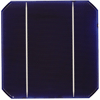
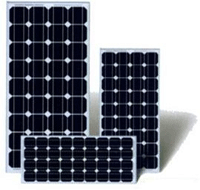
The solar cells in monocrystalline panels are slices cut from pure drawn crystalline silicon bars. The entire cell is aligned in one direction, which means that when the sun is shining brightly on them at the correct angle, they are extremely efficient. So, these panels work best in bright sunshine with the sun shining directly on them. They have a uniform blacker colour because they are absorbing most of the light.
Pure cells are octagonal, so there is unused space in the corners when lots of cells are made into a solar module. Mono mono panels are slightly smaller than poly panels for the same power, but this is only really noticeable on industrial scale installations where you may be able to fit a higher overall power with monocrystalline.
The cost of producing pure silicon wafers is a little more than for polycrystalline cells but generally there is not much difference in price these days.
Advantages
-
Monocrystalline solar panels have the highest efficiency rates since they are made out of the highest-grade silicon. The efficiency rates of monocrystalline solar panels are typically 15-20%.
-
Monocrystalline silicon solar panels are space-efficient. Since these solar panels yield the highest power outputs, they also require the least amount of space compared to any other types. Monocrystalline solar panels produce up to four times the amount of electricity as thin-film solar panels.
-
Monocrystalline solar panels live the longest. Most solar panel manufacturers put a 25-year warranty on their monocrystalline solar panels.
-
Tend to perform better than similarly rated polycrystalline solar panels at low-light conditions.
Disadvantages
-
Monocrystalline solar panels are the most expensive. From a financial standpoint, a solar panel that is made of polycrystalline silicon (and in some cases thin-film) can be a better choice for some homeowners.
-
If the solar panel is partially covered with shade, dirt or snow, the entire circuit can break down. Consider getting micro-inverters instead of central string inverters if you think coverage will be a problem. Micro-inverters will make sure that not the entire solar array is affected by shading issues with only one of the solar panels.
-
The Czochralski process is used to produce monocrystalline silicon. It results in large cylindrical ingots. Four sides are cut out of the ingots to make silicon wafers. A significant amount of the original silicon ends up as waste.
-
Monocrystalline solar panels tend to be more efficient in warm weather. Performance suffers as temperature goes up, but less so than polycrystalline solar panels. For most homeowners temperature is not a concern.
Polycrsytalline Panels (also known as multicrystalline)
Polycrystalline panels are made up from the silicon offcuts, moulded to form blocks and create a cell made up of several bits of pure crystal. Because the individual crystals are not necessarily all perfectly aligned together and there are losses at the joints between them, they are not quite as efficient. However, this mis-alignment can help in some circumstances, because the cells work better from light at all angles, in low light, etc.
The appearance is also different – you can see the random crystal arrangement and the panels look a little bluer as they reflect some
of the light.Since they are cut into rectangular blocks, there is very
little wasted space on the panel and you do not see the little diamonds
that are typical of mono or hybrid panels. Some people prefer this more
uniform appearance, others like the diamonds. The choice is yours
because the overall size and cost is very similar to monocrystalline.
Advantages
-
The process used to make polycrystalline silicon is simpler and cost less. The amount of waste silicon is less compared to monocrystalline.
-
Polycrystalline solar panels tend to have slightly lower heat tolerance than monocrystalline solar panels. This technically means that they perform slightly worse than monocrystalline solar panels in high temperatures. Heat can affect the performance of solar panels and shorten their lifespans. However, this effect is minor, and most homeowners do not need to take it into account.
Disadvantages
-
The efficiency of polycrystalline-based solar panels is typically 13-16%. Because of lower silicon purity, polycrystalline solar panels are not quite as efficient as monocrystalline solar panels.
-
Lower space-efficiency. You generally need to cover a larger surface to output the same electrical power as you would with a solar panel made of monocrystalline silicon. However, this does not mean every monocrystalline solar panel perform better than those based on polycrystalline silicon.
-
Monocrystalline and thin-film solar panels tend to be more aesthetically pleasing since they have a more uniform look compared to the speckled blue color of polycrystalline silicon.
Amorphous Cell (also called as Thin film)
Amorphous technology is most often seen in small solar panels, such as those in calculators or garden lamps, although amorphous panels are increasingly used in larger applications. They are made by depositing a thin film of silicon onto a sheet of another material such as steel. The panel is formed as one piece and the individual cells are not as visible as in other types of solar panels.
The efficiency of amorphous solar panels is not as high as those made from crystalline solar cells. Due to their lower power density; amorphous cells require up to three times the number panels for a standard installation to achieve the same power output; therefore taking up more usable space. Amorphous solar cells have a much shorter lifespan, therefore returning a much smaller investment for your investment.
Advantages
-
Mass-production is simple. This makes them and potentially cheaper to manufacture than crystalline-based solar cells.
-
Their homogenous appearance makes them look more appealing.
-
Can be made flexible, which opens up many new potential applications.
-
High temperatures and shading have less impact on solar panel performance.
-
In situations where space is not an issue, thin-film solar panels can make sense.
Disadvantages
-
Thin-film solar panels are in general not very useful for in most residential situations. They are cheap, but they also require a lot of space. Sun Power’s monocrystalline solar panels produce up to four times the amount of electricity as thin-film solar panels for the same amount of space.
-
Low space-efficiency also means that the costs of PV-equipment (e.g. support structures and cables) will increase.
-
Thin-film solar panels tend to degrade faster than mono- and polycrystalline solar panels, which is why they typically come with a shorter warranty.
Types of Solar Cells